
The AI Apocalypse Is Coming. Is Your Content Ready?
There’s a new character creeping into the healthcare patient journey.
It doesn’t sleep. It doesn’t have a waiting room. And, depending on who you ask, it may eventually take over the world. Yep. We’re talking about artificial intelligence, or AI.
Before we cue the ominous music, though, let’s look at what’s actually happening.
People are already using AI to make sense of their health. A 2026 study of US adults found that 32% of respondents had used AI for health questions. The questions spanned everything from symptoms and treatment to diagnoses and interpreting test results.
More recently, Gallup found that one in four US adults had used AI to gather healthcare information or advice. And of those recent AI users, 59% said they used it to research before seeing a doctor, while 56% used it after a visit.
In other words, AI isn’t necessarily replacing the doctor. But it’s becoming part of the conversation before and after the doctor, and that changes the job of healthcare marketing content.
Your content has two audiences now
For years, healthcare marketers have largely thought about one person when creating content: the human looking for answers.
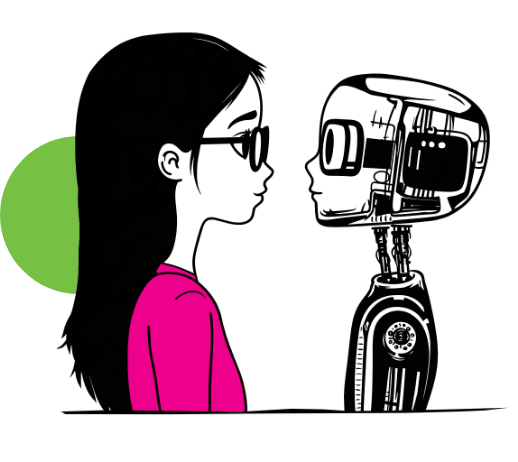
Now there’s another audience in the room. The machine helping direct them.
Sure, patients may still Google a symptom, click through a website, or read an article. But they may also ask an AI tool to summarize a condition, explain a diagnosis, compare treatment options, or help them figure out what questions to ask their doctor.
That means your content needs to be found and understood. Because somewhere between your beautifully crafted webpage and the patient sitting on the other side of the screen, an AI system is interpreting, summarizing, and deciding which pieces of information are worth surfacing.
And if your content is vague, buried, overly clever, or difficult to parse?
Well…things could get a little spooky.
So, what should healthcare marketers do?

Write for the questions people actually ask.
Patients don’t always search the way marketers think they do.
They ask things like:
- What does this diagnosis mean?
- What happens if treatment doesn’t work?
- What are the side effects?
- What should I ask my doctor?
Content that directly answers real questions is easier for humans to navigate — and easier for AI systems to interpret.
Start with the question. Then give people a clear, useful answer.

Choose clarity over cleverness.
Clever headlines are fun. We like them too. But healthcare content isn’t the place to make your audience work for the answer.
Use straightforward language. Define complicated terms. Break information into logical sections. Put important facts where people can find them.
Don’t get us wrong — your content should still have personality. It just shouldn’t require a translator.

Make the important stuff impossible to misunderstand.
If a key statistic, treatment detail, eligibility requirement, or safety consideration is buried three paragraphs into a wall of copy, you’re asking both humans and machines to work harder and leaving room for misinterpretation.
Keep related information together. Make claims specific. Clearly distinguish facts, recommendations, and next steps. Think of it as leaving a trail of breadcrumbs — except the breadcrumbs are structured information and the trail leads somewhere useful.

Give AI something credible to work with.

Create content that helps people take the next step.
The best healthcare marketing content goes beyond answering a question. It helps someone know what to do with the answer.
That might mean encouraging a conversation with a healthcare professional, explaining what to expect at an appointment, helping someone understand a treatment option, or pointing them toward additional resources.
AI can help people process information. Your content should help make that information useful.
The future isn’t necessarily human vs. machine
The Halloween version of this story is easy.
“AI is coming for your content.”
But the more interesting — and accurate — version is that AI may become another layer through which people experience healthcare information. And that’s already happening.
OpenAI reported in July 2026 that more than 300 million people turn to ChatGPT each week with health-related questions. At the same time, the company explicitly emphasizes that its health tools are designed to support — not replace — medical care.
Maybe the question isn’t whether AI will take over the patient journey. It’s whether your content will be ready when AI becomes part of it.
So, the question becomes, “If AI finds your content first, will it understand it and get it right?”
If not, that is something worth being scared of.
seriously